Writing a Good Description
Semantic Search matches on appearance, so the descriptions that work are the ones a person would use describing someone to a colleague — not the ones a database would use.
What works
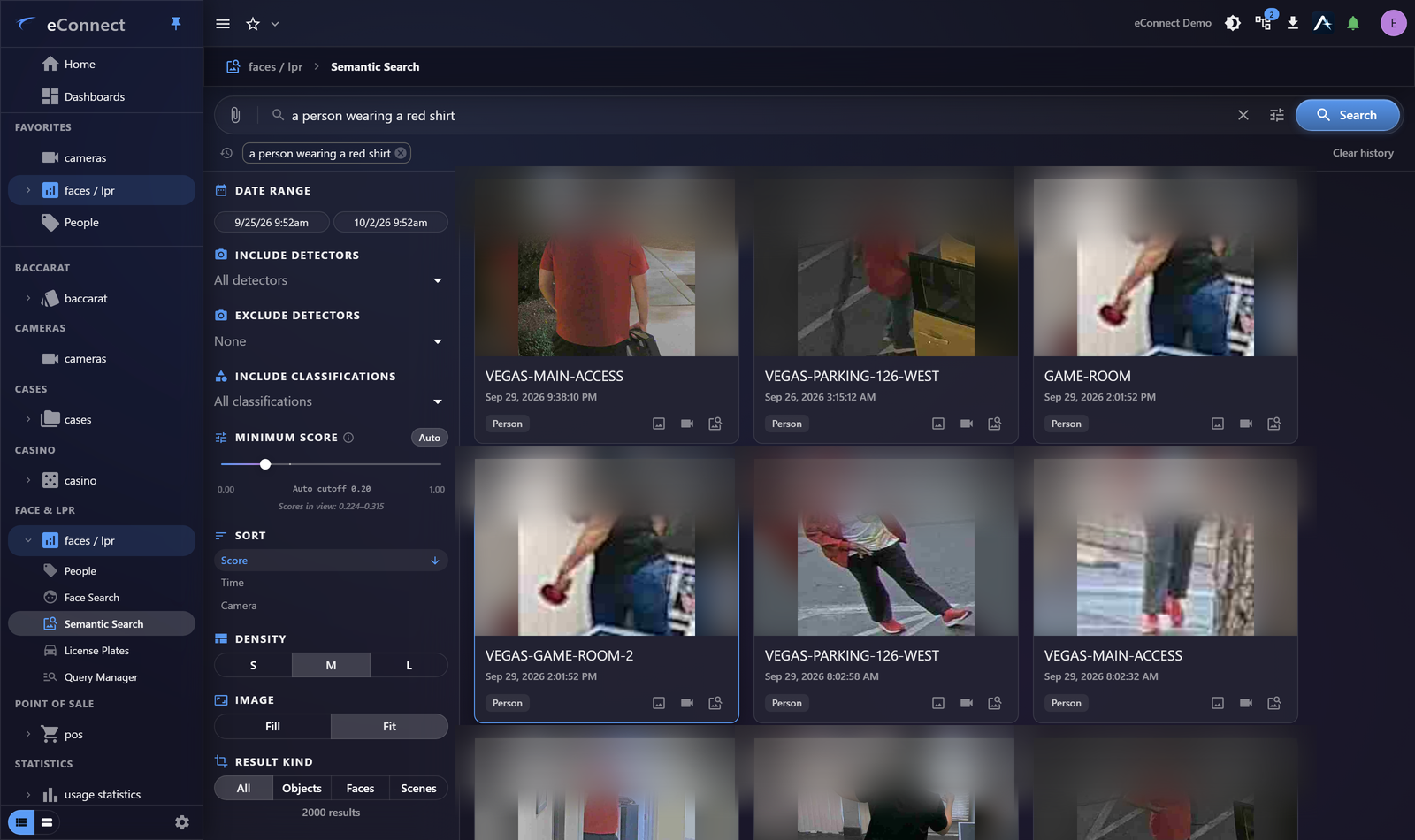
Describe visible, distinctive attributes. Searching a person wearing a red shirt returns detections of exactly that, ranked by how well each matches:
Descriptions that work well share a shape:
| Good | Why |
|---|---|
red shirt | A colour and a garment — both visible |
purple hat | Distinctive, and unlikely to be ambiguous |
red Honda Accord | Colour, make and model of a vehicle |
man in a yellow high-visibility jacket | Colour plus a recognisable garment type |
woman with a large black backpack | An object carried, with a colour |
Two or three attributes is the sweet spot. red shirt returns a great many people; red shirt and white cap returns far fewer and is much more likely to be useful.
What does not work
| Poor | Why |
|---|---|
suspicious man | Not a visible attribute |
the guy from last Tuesday | Refers to knowledge the system does not have |
John Smith | An identity, not a description — use People |
tall | Hard to judge from a single frame, and rarely distinguishing |
nice jacket | Subjective |
Anything requiring judgement, memory or identity belongs in a different tool. Semantic Search sees what a camera saw.
Colour is the strongest signal
Colour is what survives poor image quality best, and it is what witnesses remember most reliably.
Lead with it — blue jacket will outperform jacket by a wide margin.
Where a colour is uncertain — was it navy or black? — try both as separate searches rather than hedging in one description. Two focused searches beat one vague one.
Vehicles
Vehicles take colour, make, model and type: red Honda Accord, white pickup truck,
silver sedan. If make and model are uncertain, colour plus body type still works well —
dark blue SUV is a perfectly good search.
Refining rather than restarting
If a search returns too much, add an attribute. If it returns too little, remove one — over-specific descriptions fail quietly, returning nothing rather than telling you which part was too narrow.
Start slightly broader than you think you need and tighten. That way you can see what the extra attribute removed, which tells you whether it was the right one.
Using an image instead
When you have a picture rather than words, search by image — supply it and find visually similar detections. This is often better than describing what is in the photograph, because it does not lose detail in translation.
When one description is not enough
Some searches are defined as much by what you want gone as by what you want. Staff uniforms, high-visibility vests and the backs of heads crowd out the thing you are looking for, and no amount of rewording removes them — a description cannot contain a negative. Put them in the Avoid lane of Advanced Query instead, and weight the part of your description you are most sure about above the rest.
Then narrow by context
Time and place usually cut a result set down faster than more description does. A red shirt at one entrance in a twenty-minute window is a small, workable list. See Filtering and Refining Results.