Services Overview
This schema is available for generation using the Swagger OpenAPI endpoint below. It is highly recommended to generate a client from the schema before building API calls by hand.
Swagger Resources
Use these resources for code generation tools and API evaluation:
Swagger Schema:
Swagger Schema
https://dev.econnectclouddev.com/eventsbridge/swagger/v1/swagger.json
Swagger UI:
Swagger UI
https://dev.econnectclouddev.com/eventsbridge/Swagger/index.html
Auth Services
The Auth services are used to authenticate with Events Bridge and acquire a JWT token, which is required to access other services.

- Login (
POST /api/Auth/login): Authenticate by providing your username and password. On success a JWT token is returned, which must be used in subsequent API requests to other endpoints. Tokens are valid for one hour. - Renew Token (
POST /api/Auth/renew-token): Once your JWT token is close to expiration, renew it here rather than re-authenticating. This call itself requires a still-valid token.
All requests to the system must include a JWT token in the Authorization header. Use the login endpoint to retrieve one before interacting with the other APIs. See Authentication for code samples.
Face Recognition Services (FaceServices)
The FaceServices APIs handle face monitoring within the system, allowing partners to enroll, check, and remove individuals from monitoring. Each individual enrollment is tied to a unique externalId, which is supplied by the partner, making it specific to their system.
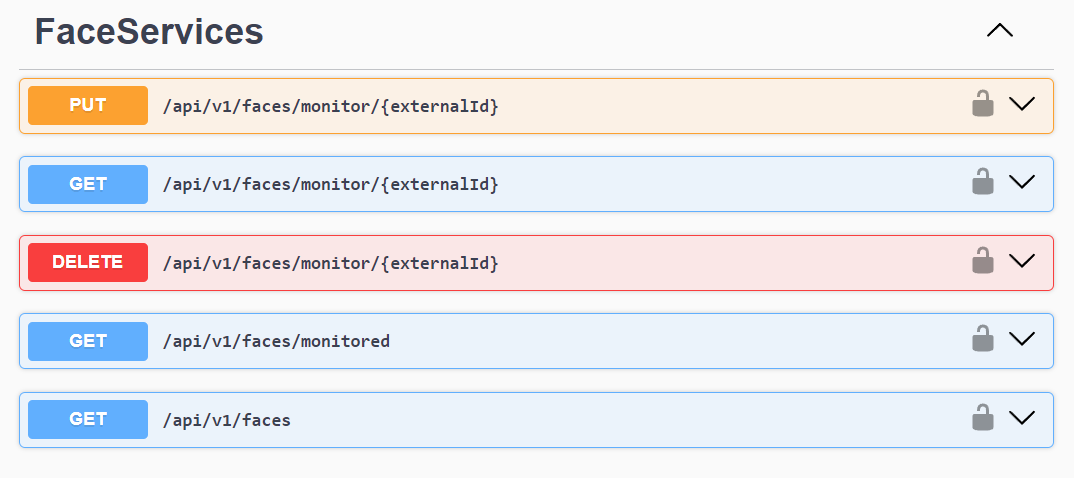
- Monitor Face (
PUT /api/v1/faces/monitor/{externalId}): Enroll a person's face by submitting theirexternalId, photo, and optional tags. See Monitoring Faces. - Check Face Monitoring Status (
GET /api/v1/faces/monitor/{externalId}): Check whether a specific face is currently being monitored. See Face Monitor Status. - Unmonitor Face (
DELETE /api/v1/faces/monitor/{externalId}): Remove a face from the monitoring system. See Unmonitoring a Face. - Get All Monitored Faces (
GET /api/v1/faces/monitored): Retrieve every face you have enrolled, with per-server enrollment status. See Get All Monitored.
License Plate Recognition Services (LprServices)
The LprServices APIs allow partners to monitor vehicle license plates. Similar to face monitoring, the externalId (supplied by the partner) ensures that each enrollment is specific to their system. The externalId does not have to be the plate itself.
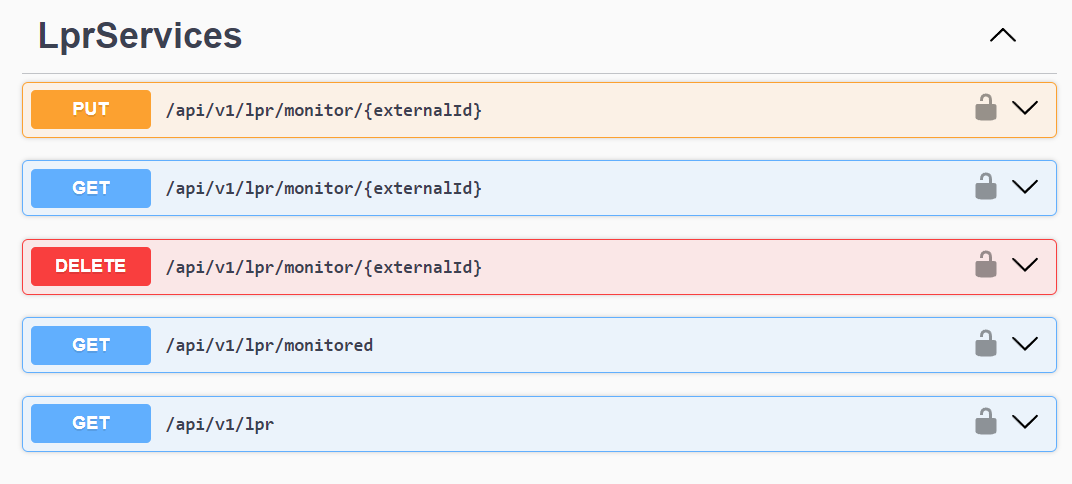
- Monitor License Plate (
PUT /api/v1/lpr/monitor/{externalId}): Enroll a vehicle's license plate for monitoring. See Monitoring License Plates. - Check License Plate Monitoring Status (
GET /api/v1/lpr/monitor/{externalId}): Verify if a specific license plate is being monitored. See License Plate Monitoring Status. - Unmonitor License Plate (
DELETE /api/v1/lpr/monitor/{externalId}): Remove a license plate from the monitoring system. See Unmonitoring a License Plate. - Get All Monitored License Plates (
GET /api/v1/lpr/monitored): Retrieve every plate you have enrolled, with per-server enrollment status. See Retrieve All Monitored License Plates.
WebHook Management (WebHooks)
The WebHooks APIs register and maintain the endpoints that Events Bridge posts detection events to. Every WebHook is addressed by a hookId in GUID/UUID form, which your system should generate once and persist.
- Create a New WebHook Template (
GET /api/v1/settings/web-hooks/new): Get a blank configuration with a freshhookId. Nothing is stored by this call. See Create a New WebHook Template. - Create or Update a WebHook (
PUT /api/v1/settings/web-hooks/{hookId}): Save a configuration. The same call creates and updates, and a save is a full replace. See Create or Update a WebHook. - Get All WebHooks (
GET /api/v1/settings/web-hooks): List your WebHooks — or all of them, for administrator accounts. See Get All WebHooks. - Get a WebHook by ID (
GET /api/v1/settings/web-hooks/{hookId}): Read one WebHook back, typically before a read-modify-write. See Get a WebHook by ID. - Send a Test Event (
POST /api/v1/settings/web-hooks/{hookId}/test): Post a synthetic detection to the configured address and report what your receiver answered. See Send a Test Event. - Delete a WebHook (
DELETE /api/v1/settings/web-hooks/{hookId}): Remove a registration and its statistics. See Delete a WebHook.
filterRules is sent as a name, not a numberThe filterRules property serializes as a string — "Expected", "AnyTagged", "SpecificTags", "AnyTaggedExceptExcluded" or "All". Do not send the underlying integer; the numeric values are not stable across generated clients.
WebHook Payload Models (WebHookModels)
These two endpoints return a fully populated example of each WebHook payload, for building a receiver or generating types before any real detection exists. They require no authentication.
- Face Payload Model (
GET /api/v1/webhook-models/face): Returns a sampleWebHookFaceRecPayload. - LPR Payload Model (
GET /api/v1/webhook-models/lpr): Returns a sampleWebHookLprPayload.
For more details on using each API call, including sample requests and responses, visit the respective sections for Authentication, Faces Management, LPR Management, WebHook Management and Web Hooks.